Get deals & exclusive offers directly in your inbox.
Introduction
New Launches In 2026
Apple's Best-Selling Products
Samsung Top Picks
Apple vs. Samsung Comparison
Final Thoughts
FAQ
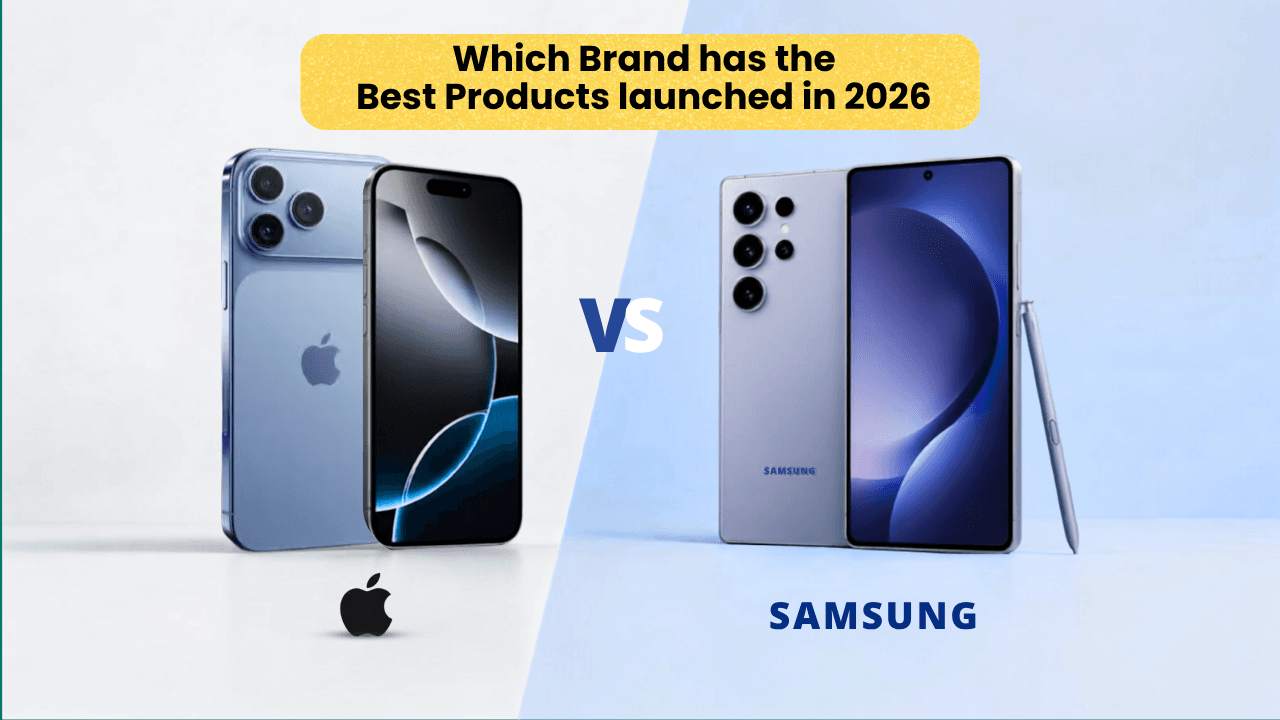
Khushi's phone slipped out of her hand for the third time this week, and this time the screen didn't survive the fall. Standing in the store the next day, she found herself stuck between two boxes: iPhone 18 Pro or Galaxy S26 Ultra? Which should she buy? Both are new launches and premium.
Khushi's confusion is the same one millions of buyers face today. The world of tech gadgets has exploded with options, but the two names people keep circling back to are Apple and Samsung. Both smartphone brands treat their flagship launches like events, chase the crown of the latest models, and promise the "best phone yet." But when you actually sit down and compare cameras, batteries, displays, and pricing, the picture gets a lot more interesting than the marketing slides suggest. This is where a real tech comparison matters — not hype, just facts.
This has been Apple's busiest and strangest year in a while. Instead of one September event with four new phones, Apple split its lineup: the iPhone 18 Pro and iPhone 18 Pro Max launched on September 9, 2026, alongside a first-ever foldable, the iPhone Duo. Apple held back the standard iPhone 18 and iPhone 18e for spring 2027, so the iPhone 17 remains its only "regular" option for now. Samsung, meanwhile, went big early. The Galaxy S26, S26+, and S26 Ultra launched in March 2026, followed by a wave of foldables at Unpacked in London — the Galaxy Z Fold8, Z Fold8 Ultra, and Z Flip8 all arrived in August 2026, plus the dual-hinge Galaxy Z TriFold earlier in the year. These latest models show two very different strategies: Apple slowing down and specialising, Samsung flooding the market with options across every tech gadget category imaginable.
Apple's headline release this year is the iPhone 18 Pro, starting at ₹1,64,900, and the iPhone 18 Pro Max at ₹1,79,900 — both ₹30,000 or more than last year's Pro models. They run on the new A20 Pro chip, Apple's first 2-nanometer processor, paired with a 48MP main camera with a variable aperture, a first for any iPhone. The Pro Max pushes battery life further, rated for up to 45 hours of video playback thanks to a battery estimated well above 5,000 mAh. For buyers who don't want to spend Pro-level money, the iPhone 17 is still Apple's go-to seller at ₹99,000, since the standard iPhone 18 won't arrive until spring 2027. Either way, anyone invested in Apple's world of tech gadgets — Watch, AirPods, iPad — still gets the same tightly connected experience the smartphone brand is known for.
Samsung's Galaxy S26 starts at ₹87,999 and comes with a 4300 mAh battery, a 50MP rear camera, and 12GB of RAM as standard — numbers that already beat Apple's non-Pro lineup. The Galaxy S26 Ultra goes further with a 5000 mAh battery and a quad-camera system built for serious photography. But 2026 wasn't just about the S-series. Samsung also pushed hard into foldables, launching the Galaxy Z Fold8, the brand-new Z Fold8 Ultra, and the slimmer.
Z Flip8, alongside the dual-hinge Galaxy Z TriFold that unfolds into a 10-inch tablet screen. Samsung has always positioned itself as the brand for people who want more screen, more battery, and more choice. Among buyers comparing raw specs, Samsung's latest models — flagship or foldable — often win the numbers game outright.
Apple | Samsung |
iPhone 18 Pro (₹1,64,900) | Galaxy S26 (₹80,000) |
iPhone 18 Pro Max (₹1,79,900) | Galaxy S26 + (₹1,08,499) |
iPhone Duo (₹2,99,900) | Galaxy S26 Ultra (₹1,39,999) |
iPhone 17 Pro (₹1,34,900) | Galaxy Z Fold 8 (1,74,999) |
iPhone 17 Pro Max (₹1,49,900) | Galaxy Z Fold 8 Ultra (1,94,999) |
List of features Apple 18 Pro Max and Samsung Galaxy S26 Ultra provide.
Features | Apple 18 Pro Max | Samsung Galaxy S26 Ultra |
Chipset | A20 pro | Snapdragon 8 Elite, Gen5 |
Battery | 5000 mAh battery | 5000 mAh with 60W |
Rear Camera | 48MP triple, Variable | 50MP Quad |
Pricing | ₹1,79,900 | ₹1,30,999 |
Standard features | Variable aperture cameras | Foldable ecosystem, S Pen support |
Both brands clearly know how to build serious tech gadgets, but they're optimising for different buyers. This kind of head-to-head tech comparison is exactly why so many shoppers stall out before checkout. Apple wins on camera innovation and long-term software support; Samsung wins on sheer variety, from ultra-thin foldables to massive-battery flagships. Neither is objectively "better" — it depends on what kind of tech gadget user you already are.
As for Khushi, she ended up going with the Galaxy S26 Ultra. Not because Samsung "won" some universal contest, but because the battery life matched her long college days better than anything else she tested. That's really the takeaway from any honest smartphone brand debate — the best phone isn't the one that wins every spec sheet; it's the one that fits your life.
Q1. Which one wins: Apple or Samsung in 2026?
Samsung wins on variety; Apple wins on camera innovation.
Q2. Which smartphone brand has better battery life right now?
Both now sit around 5,000 mAh, so it's basically a tie.
Q3. Are the latest models from both brands worth the price jump?
Not really — most people are better off with the iPhone 17 or base Galaxy S26.
Q4. Does Apple still have the better camera system?
Apple has the sharper tech, but Samsung's Ultra is more versatile.
Q5. Should I wait for the standard iPhone 18 before buying?
It depends on your budget, priorities, and how soon you need a new phone.